
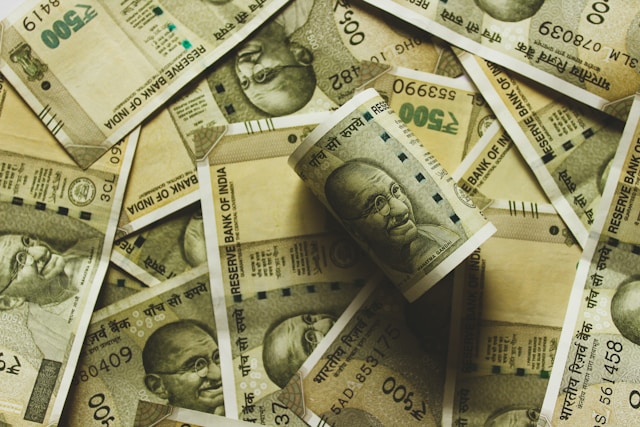
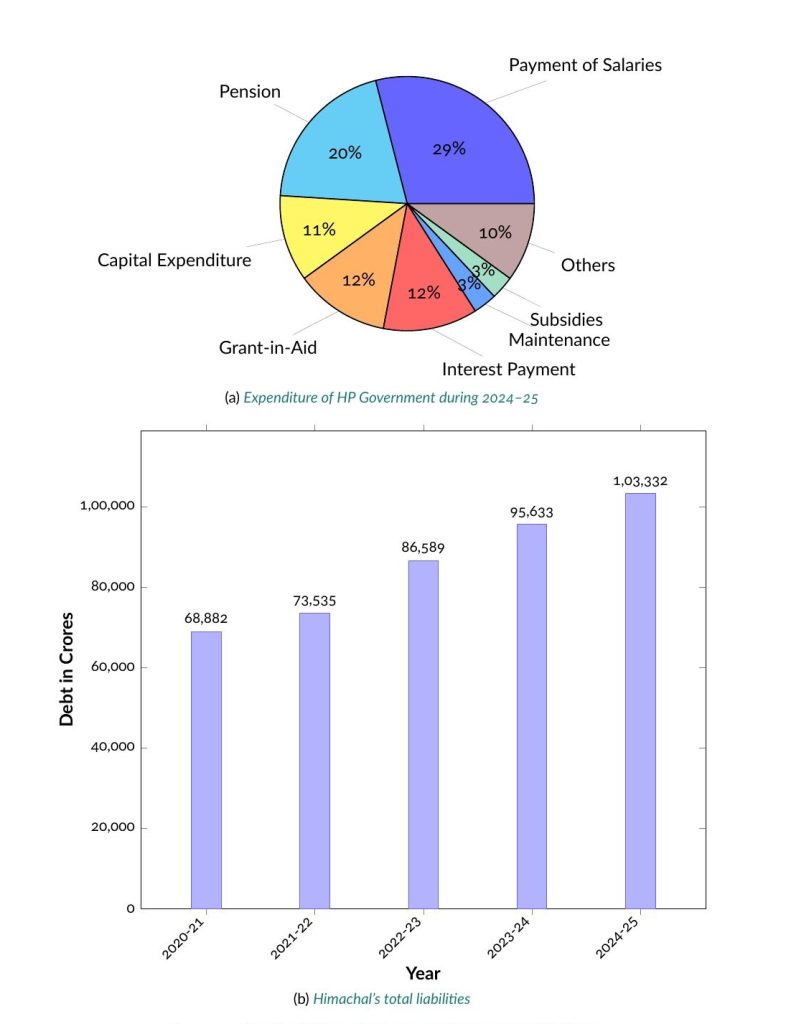
Comptroller and Auditor General (CAG) report titled “Accounts at a Glance” has pointed out that state’s total debt as of year 2024–25 has the ₹1 lakh crore mark for the first time. The state now has a total liabilities of ₹1,03,332 crores, which accounts for 45% of the state’s (Gross State Domestic Product) GSDP. According to the report, GSDP of the state stood at ₹2,32,185 crores. The liabilities of the state over the years has been shown in Figure 1.1(b). HP Government’s expenditure for 2024–25 has been shown in Figure 1.1(a).
Revenue Deficit
It is the difference between Revenue Receipts and Revenue Expenditure. Revenue Receipts includes money collected from taxes, interest from deposits/investments, and grant from the Union Government.
Revenue Expenditure is the money spent to run existing establishment of the government, like salaries, pensions, social services, etc.
Ideally, Revenue Receipts must pay for all of Revenue Expenditure.
The centre government had fixed Himachal’s net borrowing at ₹7,359 crores, and the state government availed the entire amount. During 2024–25, the government repaid debt of ₹18,169 crore.
The government took out 13 loans of ₹7,359 crores from open market, with interest rates between 7– 8%. During 2024–25, the Revenue Deficit was ₹6,805 crores, a 22.14% increase from 2023–24, when it was 5,559 crores.
Fiscal deficit increased by 11.9%, from ₹11,266 crores in 2023–24 to ₹12,611 crores in 2024–25.
Fiscal Deficit
It is the difference between total receipts (except borrowings) and total expenditure. Having a Fiscal Deficit is not a problem by itself, as long as it is being used to finance Capital Expenditure.
Out of the total borrowing of ₹26,622 crores in 2024–25, the state only utilised 22% for capital expenditure. Most of the loan amount was used to pay principal and interest of debt from previous years[1].
Bibliography
1 Accounts at a Glance (Forest Department, Government of Himachal Pradesh, 2025).


![Gandhian Thoughts - English [Paperback]](https://sarlapublications.com/wp-content/uploads/2018/11/Gandhian-Thoughts-250x345.jpeg)

![हिमाचल पर्देश का भूगोल - Himachal Pradesh ka Bhugol [Hindi]](https://sarlapublications.com/wp-content/uploads/2019/10/HP_ka_Bhugol_Title-250x322.jpeg)