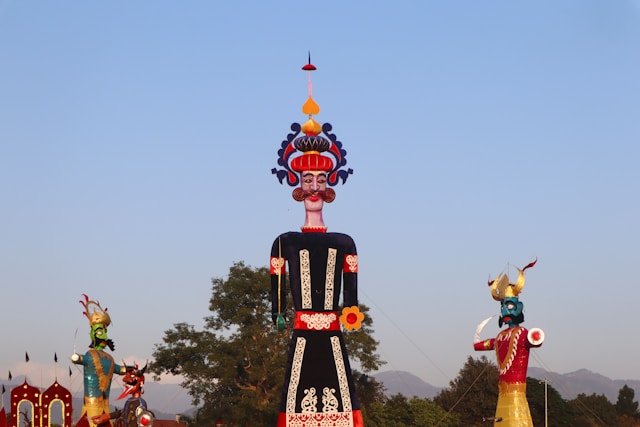
International Kullu Dussehra Festival was held from October 2–8, 2025. During the festival, Kullu transforms into a sacred site of devotion, with celebrations taking place in five distinct locations: Dhalpur, Manikaran, Naggar Thawa, Haripur, and Vashisht. The main hub of the festivities is Dhalpur, where a seven-day celebration is held, accompanied by a month-long trade fair.
In Manikaran, Haripur, and Naggar Thawa, local devtas (deities) participate in the rituals. In Manikaran, a chariot procession of Lord Rama is held, joined by numerous other deities, including Mata Naina Devi. Haripur and Naggar Thawa also witness large processions.
The Kullu Dussehra festival is believed originated in the mid-17th century during the rule of Raja Jagat Singh (1637–1672). It is said a brahmin who resided at Tippai possessed three pounds of pearls. Jagat Singh demanded pearls from the brahmin. In some stories, the Raja asked for the brahmin’s daughter[1]. Instead of submitting to the order, the brahmin set fire to his house and died along with his family. Jagat Singh was cursed, and everything he saw, smelt, or tasted, seemed to be smeared with blood. He consulted his pandits, who told him to fetch and install idol of Lord Raghunath (or Ram and Sita) on his throne.
He sent a brahmin named Damodar[2] to Ayodhya, to fetch the idol. According to some stories, Damodar stole[1, 2] the idol. The Raja installed the idol on the throne and declared himself as a mere “Chhadibardar” or Chief Caretaker/Vicegerent of the Lord. The Raja was freed from his curse, and from that day, Lord Raghunath was said to be the ruler of Kullu.
Jagat Singh invited deities from across the valley, thus initiating the tradition of celebrating Dussehra festival in Kullu. In 2025, 332 devtas were invited to attend the festival.
Today, along with its immense historical, cultural, and spiritual significance, the festival has also become a major economic and social event, attracting millions of visitors and generating crores of rupees in trade and tourism.
In the past, the temples of various devtas of Kullu held considerable land in the princely state. At the end of the 19th century, the temples held land that accounted for around one-seventh (14.3%) of all revenue from cultivated land in the state[1].
Bibliography
1Gazetteer of the Kangra Districts – Part II -IV – Kullu, Lahul, and Spiti (Punjab Government, 1899).
2, History of Kangra and Kulu States (Northern Book Centre, 1986).
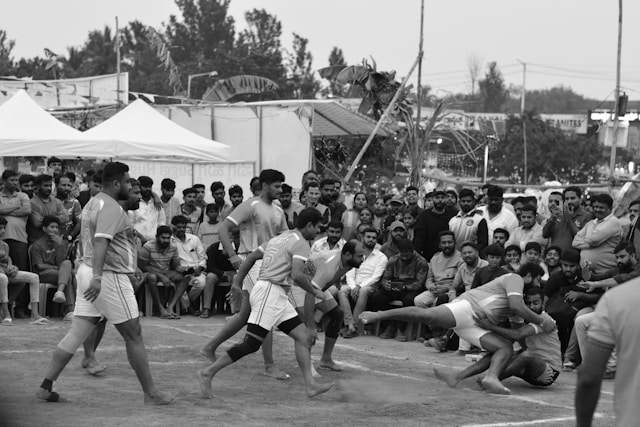
Photo by Dilip Poddar on Unsplash


![हिमाचल पर्देश का भूगोल - Himachal Pradesh ka Bhugol [Hindi]](https://sarlapublications.com/wp-content/uploads/2019/10/HP_ka_Bhugol_Title-250x322.jpeg)
![Gandhian Thoughts - English [Paperback]](https://sarlapublications.com/wp-content/uploads/2018/11/Gandhian-Thoughts-250x345.jpeg)