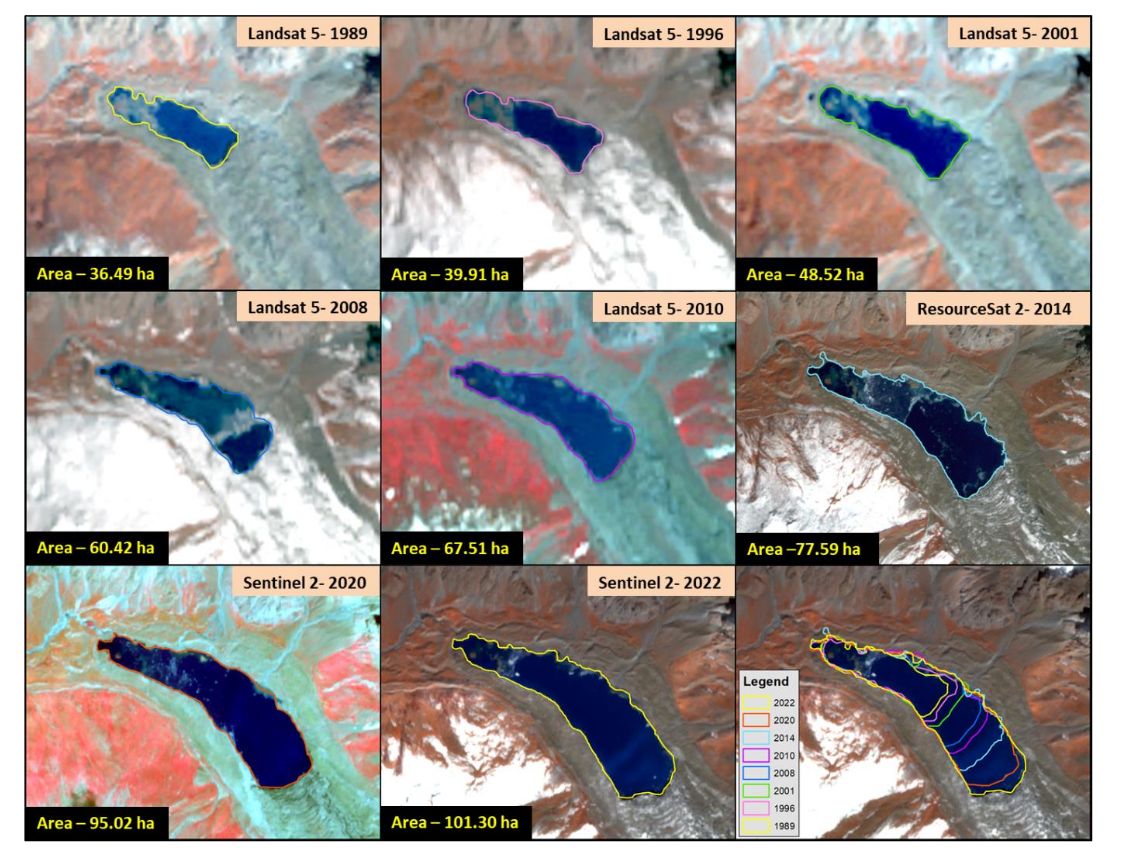
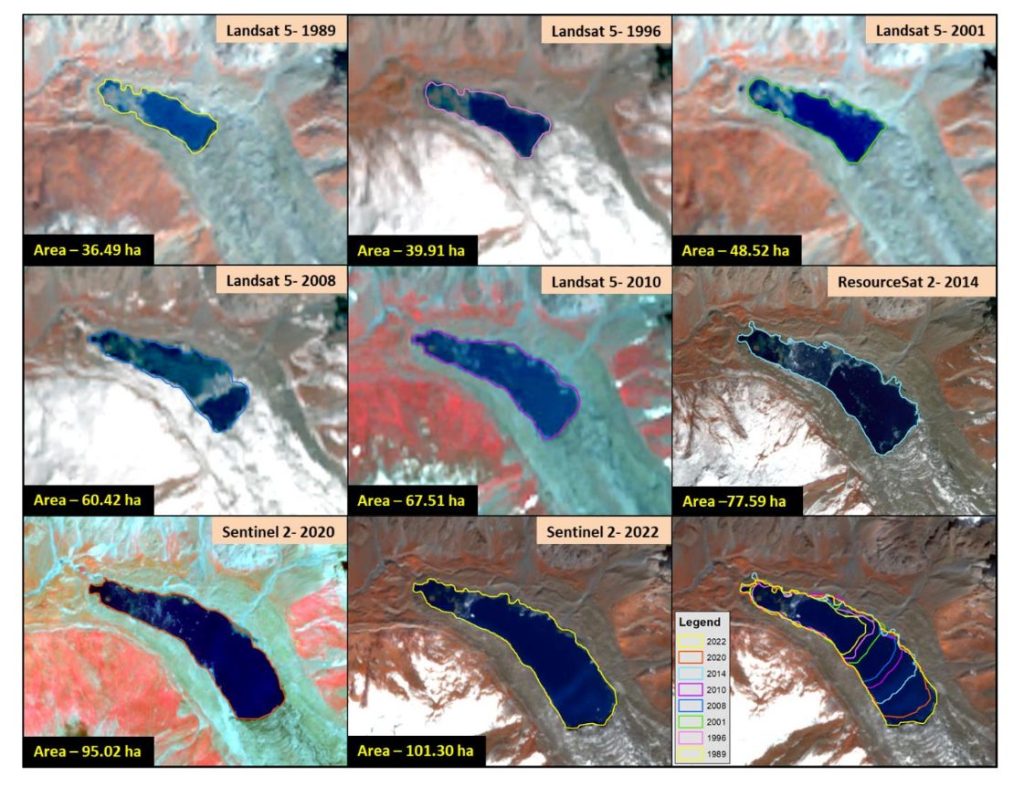
Ghepan Lake’s expansion over the years[1]
Ghepan Lake in Lahaul, situated at an altitude of 4068.7m[1] above sea level, has expanded by 178 percent over the past 33 years (from 36.49 ha to 101.30 ha). According to a study done in 2022 under the National Hydrology Project, the lake covers an area of 101.30 hectares and is approximately two and a half kilometers long. The study states that the expanding lake is emerging as a serious threat to the Chenab Valley.
The National Remote Sensing Centre has warned that a possible breach of the lake could lead to large-scale destruction from Jammu to Pakistan. The Central Water Commission and the Centre for Development of Advanced Computing, functioning under the Ministry of Electronics and Information Technology, have also been monitoring the lake for several decades.
According to the 2022 study, the lake measures 2,464 meters in length and has a maximum width of 625 meters.
Useful Books for Competition
-
महात्मा गाँधी – सम्पूर्ण विचारों का संगृह Complete Archive of Thoughts (Hindi)
Original price was: ₹140.00.₹120.00Current price is: ₹120.00. -
हिमाचल पर्देश का भूगोल – Himachal Pradesh ka Bhugol [Hindi]
Original price was: ₹250.00.₹200.00Current price is: ₹200.00. -
Gandhian Thoughts – English [Paperback]
Original price was: ₹140.00.₹120.00Current price is: ₹120.00.

![हिमाचल पर्देश का भूगोल - Himachal Pradesh ka Bhugol [Hindi]](https://sarlapublications.com/wp-content/uploads/2019/10/HP_ka_Bhugol_Title-250x322.jpeg)
![Gandhian Thoughts - English [Paperback]](https://sarlapublications.com/wp-content/uploads/2018/11/Gandhian-Thoughts-250x345.jpeg)
Formed by melting glaciers, Ghepan Lake is considered the largest lake in Himachal Pradesh. It currently holds nearly 35.08 million cubic meters of water. The report states that a breach of the lake could pose a serious danger to the Chenab Valley.
It further notes that the risk may increase if the lake continues to expand due to the rapid melting of glaciers and rising water levels. Because of this, Ghepan Lake has been included in the list of sensitive high-risk lakes in the country. It has been classified as “highly vulnerable” by the National Disaster Management Authority (NDMA).
The effects of global warming have become increasingly visible in the Himalayan region over the past two decades. Tourism activities in Lahaul-Spiti district have also increased during this period, leading to a rise in the number of vehicles in the region.
As a result, glaciers and snow-covered mountain peaks are melting at a faster rate, contributing to the continued expansion of Ghepan Lake.
Bibliography
1GLOF Risk Assessment of Ghepan Ghat Glacial Lake in Indus River Basin (Indian Space Research Organisation, 2023).